
Category: More
Built-in-Place and Modular Vegetated Systems
Traditionally, vegetation has been established on roofs using plugs, cuttings or seeds. These are called built-in-place vegetated systems. The initial vegetation coverage typically ranges 5-15% and it takes regular TLC (water, weed and feed) and patience (1-3 years) for the young plants to mature and establish.
Increasingly, vegetation is first pre-grown in modules on the ground for quicker establishment on the roof. These are called modular vegetated systems. These pre-vegetated modules contain mature plants with 80+% vegetation coverage at delivery, and typically takes only one growing season to establish on the roof.
If we could use an analogy comparing establishing a green roof to starting a front lawn, built-in-place systems would be akin to sowing seeds. Modular systems would be equivalent to laying sod. Instant green, ease of installation, reduced establishment time and maintenance efforts are some attributes that make modular vegetated systems such as mats and trays popular in North America.
Modular Pre-Vegetated Mat and Tray Systems
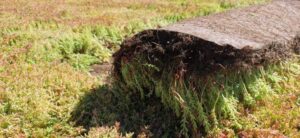
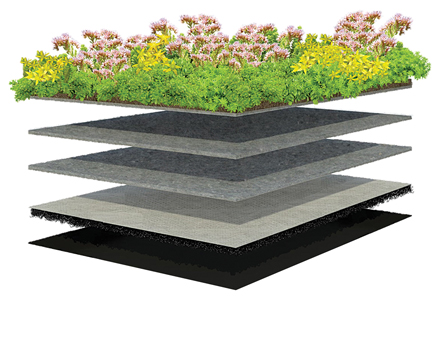
Pre-vegetated mats contain vegetation planted in a shallow growing medium (2-3 cm) on a vegetation carrier. Natural carriers made of coir fibre matting decompose over time and integrate into the media. Synthetic carriers consisting of 3D entangled mesh provide enhanced root anchorage and mat integrity, which are suited for sloped roofs. They are durable and can be readily rolled back, even many years later, for membrane access. Pre-vegetated mat systems are loose laid, yet highly wind resistant.
Pre-vegetated trays contain vegetation planted in containers resembling shallow planter boxes. They are made of plastics or metals and come in different sizes, typically containing 5–20 cm of growing medium. Some trays are designed to be fastened or interlocked together for stability and wind resistance. There are also trays that are made of natural materials that decompose and integrate into the media over time.
Why Vegetated Mat Systems Dominate
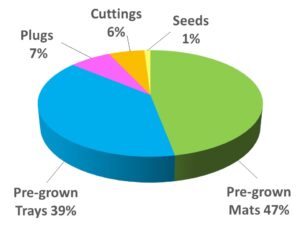
Green Roofs for Healthy Cities, a North American green roof industry association, conducted a detailed market survey in 2016. They showed that mats topped the North American market at 47% followed by trays at 39%. The difference is even higher when it comes to extensive systems 56% for mats vs. 29% for trays.
- Lighter weight: 60-150 kg/m2 for mat systems vs. 200-300 kg/m2 for trays
- More economical: $150-200/m2 for mat systems vs. $250-350/m2 for trays
- No membrane puncture hazards: mat systems are flexible and do not contain any sharp edges or corners
-

Pre-vegetated mats are easy to cut and conform around drains, penetrations and curved and organic landscapes. Easy to cut and conform: mat systems are easier and less messy to cut around drains and penetrations, they fit curved and organic landscape design without looking “pixelated” and conform well to 3D contours such as dome or wavy shaped rooftops
- Quicker installation: a typical mat is about 10X the size of a typical tray. Mats and baselayers are flexible and much easier to cut than the hard trays. These save as much as 25% labour on large roofs
- Easy membrane access: mat systems, especially soilless, can be readily rolled back or cut for membrane access. It is more difficult with trays as they are either interlocked or “jammed” tight over time.
Biodiversity in Trays and Mats
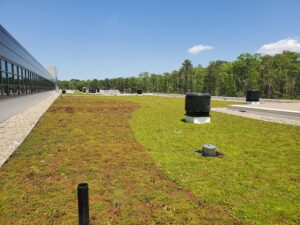
Trays, especially deeper ones (10–20 cm), can accommodate larger plants. Extensive mat systems can also incorporate larger plants with the BioBerm™.
Supplier of more than 2.5 M SQFT Coast-to-Coast
Canada’s leading supplier of pre-vegetated roofs, NLSM customizes to local requirements, offers warranty & maintenance support, provides stormwater calculations specific to location and building/roof type, stormwater test data & related innovative hydrologic modeling. Click here to get started on your next green roof.
More than 85 Years Experience
Next Level Stormwater Management (NLSM) is Canada’s leading supplier of pre-vegetated roofs such as LiteN’Less™ and StormCap™ systems. NLSM’s team has more than 85 years of combined green roof industry experience: helping with stormwater calculations and technical advice, design, planning and maintenance support, assisting with required documentation, issuing P.Eng-stamped wind reports and supplying and delivering the complete system package.
Enjoy this rare bird’s eye view of NLSM green roofs!
Supplier of more than 2.5 M SQFT Coast-to-Coast
Canada’s leading supplier of pre-vegetated roofs, NLSM customizes to local requirements, offers warranty & maintenance support, provides stormwater calculations specific to location and building/roof type, stormwater test data & related innovative hydrologic modeling. Click here to get started on your next green roof.
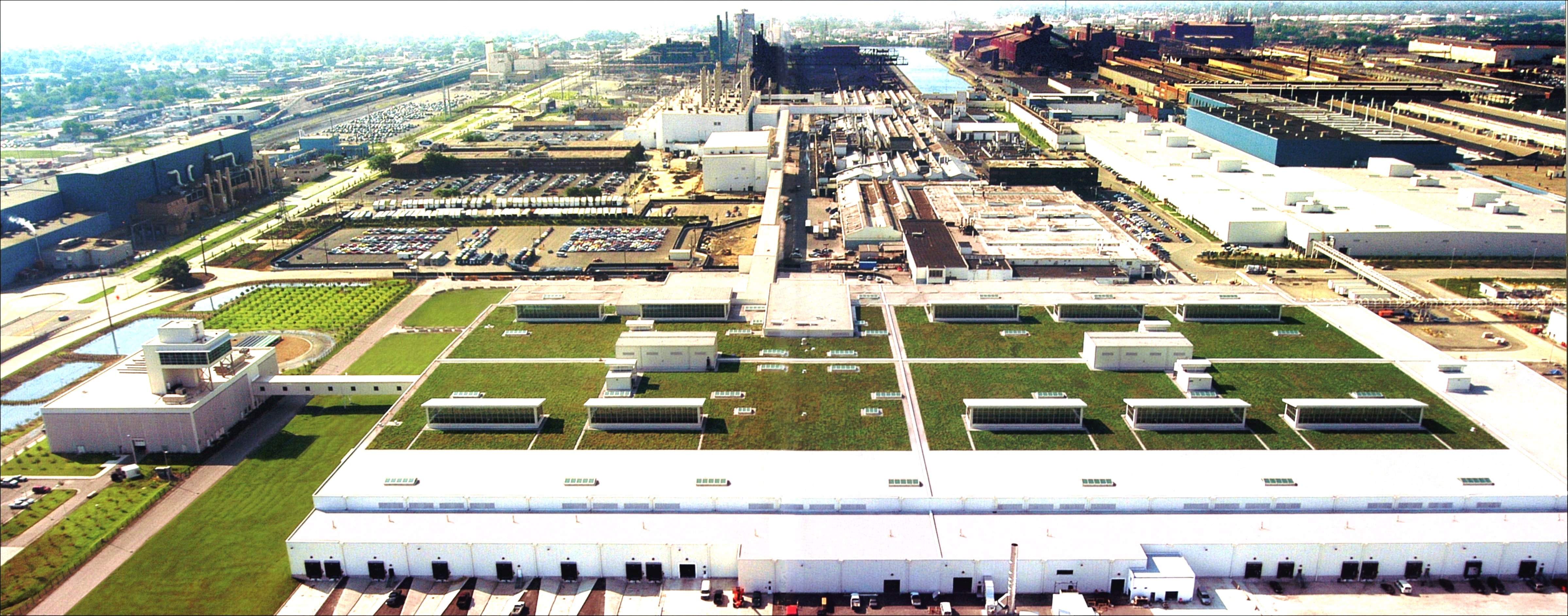
Facts about Xeroflor green roof on Ford Truck Plant
by Dr. Clayton Rugh
Reposted with permission from http://planetsave.com/2015/07/23
The lightweight and soilless Xeroflor green roof system was selected for the Ford plant after years of technical testing and development between Michigan State University, William McDonough + Partners architecture design firm, McDonough Braungart Design Chemistry, Ford’s Environmental Quality Office and others. The creator of the Xeroflor technology – the late Mr. Wolfgang Behrens – was invited to submit his recommended green roof assembly side-by-side trials with other systems – all of which were several inches deeper. Mr. Behrens’ 30 years of experience (at the time of the 2001 test period) and thousands of reference projects around the world were driving reasons to extend this invitation.

Advantages of a Lightweight and Soilless Green Roof
The research conducted at MSU’s horticultural testing facility clearly showed the technical advantages of Mr. Behrens’ Xeroflor assembly. In addition, numerous external experts in building envelope performance, horticultural science, and landscape design were consulted during this process. The collaborative research team was unanimous in its selection of the soilless Xeroflor system for the Rouge green roof.
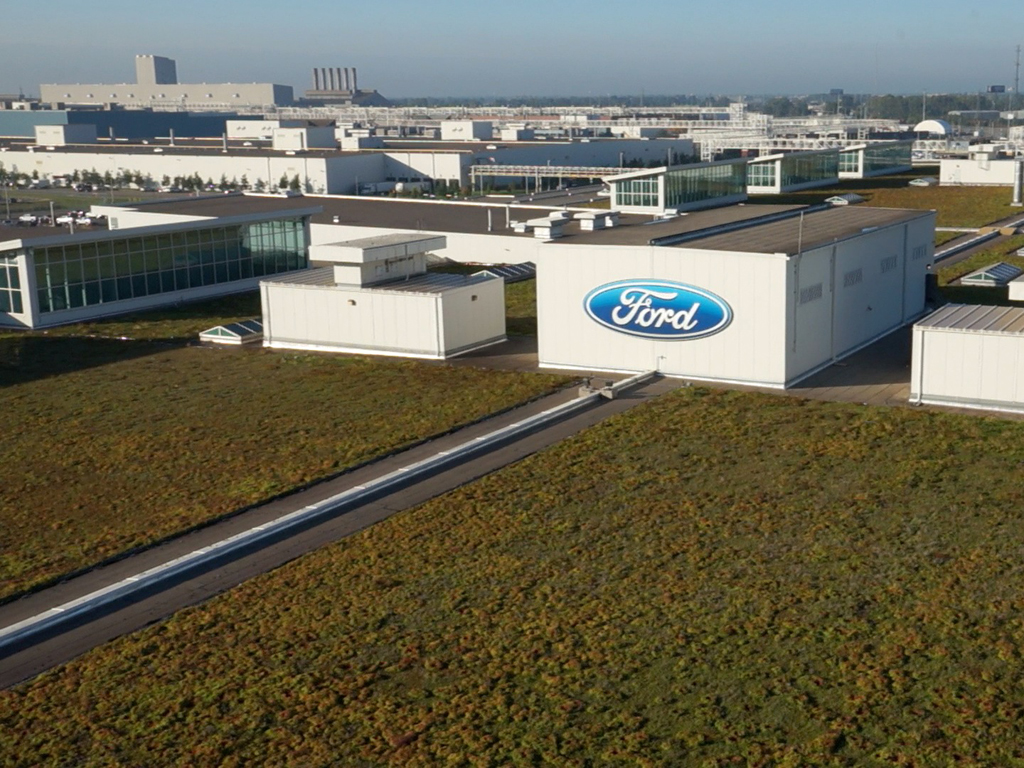
Ford’s green roof was installed in Fall 2002 with completion of the “establishment period” by Summer 2003. The exact same green roof materials and assembly components installed in 2002 are still in place today and have never been replaced or replanted.
Thousands Visit Green Roof Annually

Ford elected to have an irrigation system installed as part of the green roof project as an “insurance policy”, since the green roof would be viewed by thousands of Rouge Plant visitors each year as part of their Factory Tour program and they wanted to avoid any temporary setbacks during periods of extreme or prolonged drought or hot weather. The irrigation system was operated very rarely, has received only routine maintenance to maintain it in working order should the need arise for its operation, and has never been replaced or dismantled.
Follow-up survey studies of the Ford green roof led by Michigan State University in 2008 and 2009 showed that 13 of the original 15 plant species were still present and covered approximately 95% of the 10.2 acre green roof area.
Low Maintenance Green Roof
Other than infrequent watering during this establishment stage after installation, the Ford green roof receives a minimal spring-time fertilizing every 1 to 2 years. No weeding has been needed because weedy plants have never been observed to establish or colonize on the Ford green roof. These low-maintenance-by-design advantages have saved Ford an immense amount of money that would otherwise have been required to service deeper profile, heavier, and more weed-prone systems.
Dr. Clayton Rugh was part of the Michigan State Univ research team that initially evaluated the various green roof systems for the Ford project and since 2006 have represented Xeroflor in the US overseeing nearly 400 successful, thin-profile green roof installations including other landmark projects such as the Jacob K. Javits Convention Center in NYC and the FEDEX Ship Centre at O’Hare International Airport. First posted online at http://planetsave.com/2015/07/23.
Next Level Stormwater Management is the Supplier of More Than 2.5 Million SQFT Coast-to-Coast
NLSM, formerly known as Xeroflor Canada Inc, is Canada’s leading supplier of the soilless LiteN’Less™ systems systems. We customize to local stormwater management and biodiversity requirements. Email or call (416) 637-5772 Ext 1.